Test automation can help software teams reduce repetitive testing effort, improve testing consistency, and accelerate feedback during development. However, successful automation does not happen simply by selecting an automation tool and writing tests.
Without a clear plan, teams can automate the wrong test cases, create difficult-to-maintain scripts, or invest significant resources without achieving meaningful improvements.
This is why a test automation roadmap is important.
A well-designed roadmap gives QA and development teams a structured way to decide what to automate, where to start, how to measure progress, and how to expand automation over time.
In this guide, we will explain how to build an effective test automation roadmap, from evaluating your current testing process to selecting test cases, implementing automation, measuring results, and scaling your strategy.
What Is a Test Automation Roadmap?
A test automation roadmap is a structured plan for introducing, developing, and expanding automated testing within a software testing process.
It defines the steps an organization should take to move from its current testing approach toward a more efficient automation strategy.
A roadmap can cover areas such as:
- Current testing assessment
- Automation goals
- Test case selection
- Automation priorities
- Tool and framework selection
- Pilot implementation
- Test maintenance
- Integration into development workflows
- Performance measurement
- Scaling automation
The roadmap should reflect the organization’s actual software, testing requirements, resources, and business priorities.
There is no single automation roadmap that works for every company.
Why Do You Need a Test Automation Roadmap?
Test automation can provide significant benefits, but automation itself is not the final objective.
The objective is to improve the overall testing process.
Without a roadmap, teams may encounter problems such as:
- Automating low-value test cases
- Creating too many fragile automated tests
- Choosing tools without considering project requirements
- Spending too much time maintaining automation
- Measuring automation by test count instead of business value
- Trying to automate everything at once
A roadmap helps teams make automation decisions systematically.
Instead of asking, “What can we automate?”, teams can ask a more valuable question:
“What should we automate to create the greatest testing value?”
Step 1: Assess Your Current Testing Process
Before introducing new automation, understand where your testing process currently stands.
Review how testing is performed today.
Consider questions such as:
- Which tests are currently manual?
- Which tests are repeated frequently?
- How long do regression tests take?
- Which tests are most important to the business?
- Where do testing bottlenecks occur?
- Which tests frequently fail?
- How often does the application change?
- What testing resources are available?
This assessment provides a baseline for your automation roadmap.
It also helps prevent teams from automating simply for the sake of automation.
Identify Repetitive Testing
Repetitive test scenarios are often good candidates for automation.
For example, if the same regression scenarios must be executed after every significant software change, automating suitable parts of that process can reduce repetitive manual effort.
However, repetition alone should not determine automation priority.
Business importance, stability, maintenance effort, and execution frequency should also be considered.
Step 2: Define Your Automation Goals
Once you understand the current testing process, define what you want automation to achieve.
Different organizations may have different priorities.
Your goals might include:
- Reducing regression testing time
- Increasing test execution frequency
- Improving test consistency
- Providing faster feedback
- Increasing test coverage
- Supporting frequent software releases
- Reducing repetitive manual testing
- Improving visibility into test results
Clear goals make it easier to evaluate whether automation is actually delivering value.
For example, “automate 500 tests” is not necessarily a meaningful business objective.
“Reduce regression execution time while maintaining reliable coverage of critical workflows” provides a much clearer direction.
Step 3: Identify the Right Tests to Automate
One of the most important decisions in a test automation roadmap is determining which tests should be automated.
Not every test is a good candidate.
A test may be suitable for automation when it is:
- Repeated frequently
- Stable and predictable
- Time-consuming to execute manually
- Important for regression testing
- Based on clear expected results
- Suitable for repeated execution
Tests that require extensive human judgment or frequent interpretation may be better candidates for manual testing.
Prioritize High-Value Test Cases
Automation should start with tests that provide meaningful value.
A useful way to prioritize test cases is to consider:
Business impact + execution frequency + stability + automation effort
A high-priority test might be an important business workflow that is executed frequently and has stable expected results.
A low-priority test might be rarely executed, constantly changing, or expensive to automate.
This approach helps teams focus their resources where automation can have the greatest impact.
Step 4: Decide What Should Remain Manual
An effective test automation roadmap should not assume that everything needs to be automated.
Manual testing continues to be valuable.
Some testing activities benefit from human observation, judgment, and exploration.
For example, exploratory testing can help testers discover unexpected behaviors that predefined automated scenarios may not identify.
Usability-related observations can also require human evaluation.
Therefore, the goal should be to create the right combination of automated and manual testing, rather than eliminating manual testing entirely.
Automation should reduce repetitive work while allowing testers to focus on activities where human expertise provides greater value.
Step 5: Choose the Right Automation Tools and Framework
Tool selection is another important part of a test automation roadmap.
The best tool depends on the organization’s technical environment and testing requirements.
Before selecting a tool, consider:
- Application technology
- Programming language requirements
- Browser and platform requirements
- Existing QA skills
- Integration requirements
- Test maintenance
- Reporting capabilities
- Scalability
- Long-term project requirements
Teams should avoid selecting a tool simply because it is popular.
The tool needs to fit the actual testing environment.
Consider Existing Skills
An automation framework is only useful when the team can effectively work with it.
Consider the programming languages, technical skills, and automation experience already available within the QA and development teams.
If a selected framework requires skills that the team does not currently have, training and onboarding should become part of the roadmap.
Step 6: Start With a Pilot Project
Trying to automate an entire application immediately can create unnecessary complexity.
A better approach is to start with a focused pilot.
Choose a limited set of high-value test cases and use them to validate your automation approach.
The pilot can help the team evaluate:
- Tool suitability
- Test stability
- Execution time
- Maintenance requirements
- Reporting
- Team capabilities
- Automation value
The results can then be used to improve the broader automation roadmap.
A successful pilot provides evidence before the organization makes a larger investment.
Step 7: Build Maintainable Automated Tests
Creating automated tests is only the beginning.
Tests also need to remain reliable as the application changes.
Poorly designed automation can become difficult to maintain and may produce unreliable results.
A sustainable automation strategy should consider:
- Reusable test components
- Clear test structure
- Maintainable test data
- Stable test environments
- Meaningful test reporting
- Clear ownership
- Regular maintenance
A large number of automated tests is not necessarily a sign of a successful automation program.
Reliable and maintainable automation is more valuable than a large collection of unstable scripts.
Step 8: Integrate Automation Into the Testing Workflow
Once automated tests have been validated, they should become part of the broader QA workflow.
Automation can provide value when tests are executed regularly rather than only when someone remembers to run them.
Depending on the development process, automated testing can support different stages of software delivery.
For example:
Code Change → Automated Tests → Results → Defect Analysis → Fix → Retest
This creates a feedback loop between development and testing.
Frequent feedback can help teams identify problems earlier and reduce the likelihood of discovering large numbers of defects immediately before release.
Step 9: Measure Automation Success
A test automation roadmap should include measurable outcomes.
However, measuring only the number of automated tests can provide a misleading picture.
Instead, consider metrics such as:
Test Execution Time
How long does it take to execute important regression scenarios?
Automation Stability
How consistently do automated tests produce reliable results?
Maintenance Effort
How much time is required to maintain automated tests after application changes?
Defect Detection
How effectively does automation help identify defects?
Test Coverage
Which important application areas are covered by automated tests?
Feedback Speed
How quickly can developers receive information about the impact of a change?
These metrics provide a more useful view of automation performance.
Step 10: Expand Automation Gradually
Once the initial automation process is stable, the organization can expand it.
Avoid treating automation as a one-time project.
Software changes continuously, so the automation strategy should evolve with it.
Expansion may involve:
- Adding additional regression scenarios
- Increasing coverage of critical workflows
- Automating additional platforms
- Improving reporting
- Integrating additional testing stages
- Increasing automation execution frequency
The roadmap should be reviewed periodically to ensure that automation priorities still match business and software requirements.
Common Test Automation Roadmap Mistakes
Even organizations with experienced QA teams can encounter problems when building automation strategies.
Trying to Automate Everything
Not every test provides enough value to justify automation.
Automation decisions should consider business value, stability, frequency, and maintenance effort.
Focusing Only on the Number of Tests
A large test suite does not automatically mean better software quality.
Ten reliable tests covering critical workflows can provide more value than hundreds of unstable tests.
Ignoring Maintenance
Applications change.
Automated tests must change with them.
Maintenance should therefore be included in the roadmap from the beginning.
Selecting Tools Before Understanding Requirements
Starting with a tool rather than a testing problem can lead to poor technology decisions.
First define the requirements. Then evaluate the available automation approach.
Not Measuring Results
If teams do not measure execution time, stability, maintenance effort, coverage, and other relevant outcomes, it becomes difficult to determine whether automation is delivering value.
How Test as a Service Can Support Test Automation
Building and maintaining a test automation program requires expertise, resources, and continuous effort.
Some organizations may have strong internal QA teams but limited automation capacity. Others may need specialized support for a particular project or testing requirement.
This is where Test as a Service can complement an internal QA strategy.
A tTaaS model can provide access to professional testing expertise without requiring an organization to build every testing capability internally.
For organizations developing a test automation roadmap, external testing services can support areas such as:
- Automation development
- Functional testing
- Test data management
- Performance testing
- Test analysis
- Test result reporting
This can be particularly useful when an organization wants to expand its automation capabilities while maintaining its existing internal QA processes.
How tTaaS Supports Test Automation
TDG’s tTaaS provides a comprehensive portfolio of testing services that includes functional testing, test automation, test data management, and performance testing.
Its approach combines intelligent automation with modern testing technologies to help organizations improve software quality, manage testing costs, and accelerate delivery.
For a company developing or expanding its automation roadmap, tTaaS can provide support across different testing requirements.
Test Automation Services
Test automation is one of the core services included in tTaaS.
The objective is to help organizations introduce automation into their testing processes and use automated testing where it provides meaningful value.
Functional Testing
Automation works best when combined with appropriate functional testing.
Functional testing can help teams validate whether software behaves according to expected requirements.
Test Data Management
Automation requires appropriate test data.
tTaaS provides test data management services to create, manage, and deliver test data to application teams in a structured and efficient way.
Performance Testing
A comprehensive automation strategy should not focus exclusively on functional regression testing.
Performance testing can help teams evaluate software behavior under expected workloads and identify potential performance issues.
Visibility and Transparency in the Automation Process
A successful test automation roadmap also needs visibility.
Teams need to understand what has been completed, what is currently being worked on, and where resources are being used.
tTaaS supports:
- Real-time test case tracking
- Accurate time reporting
- Executive-ready metrics and dashboards
- Visual quality metrics
- Time and resource transparency
- Kanban and Gantt-based workflows
- Transparent test-hour tracking
These capabilities can help QA managers and business stakeholders understand testing progress and resource usage.
The result is a more transparent testing process rather than an automation program that operates without clear visibility.
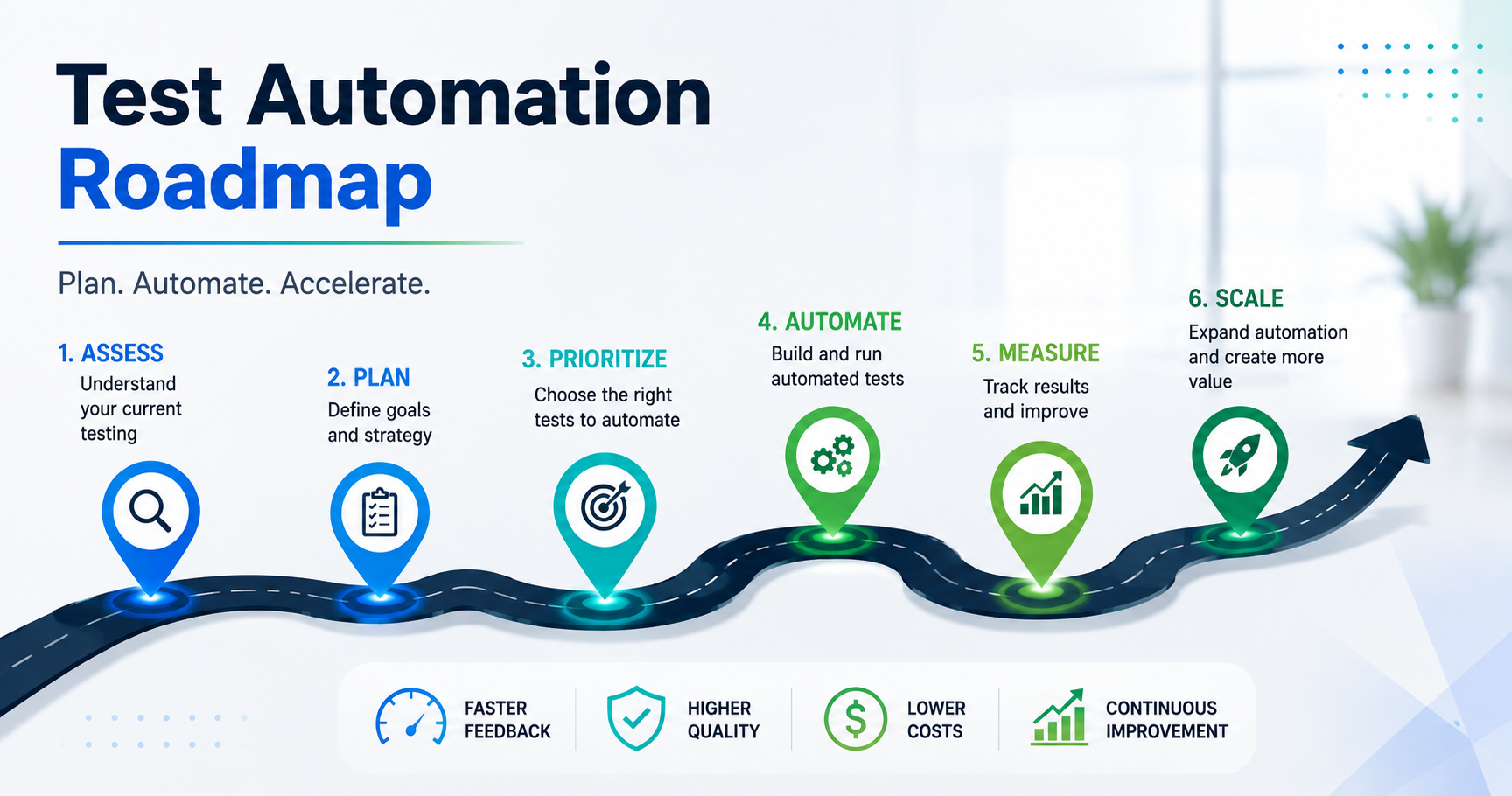
A Practical Test Automation Roadmap
A simple roadmap can be organized into five stages:
Phase 1: Assess
Understand the existing testing process and identify the biggest opportunities for improvement.
Phase 2: Prioritize
Select high-value test cases based on business importance, frequency, stability, and automation effort.
Phase 3: Pilot
Automate a focused group of test cases and evaluate the results.
Phase 4: Integrate
Make automation part of the regular software testing and development workflow.
Phase 5: Scale
Expand automation coverage gradually while continuously measuring reliability, maintenance effort, and business value.
This phased approach helps teams avoid trying to solve every automation challenge simultaneously.
Conclusion
Building an effective test automation roadmap is not about automating the largest possible number of tests.
It is about creating a structured strategy that identifies where automation can deliver the greatest value.
By assessing the current testing process, defining clear goals, prioritizing high-value test cases, selecting suitable tools, starting with a pilot, measuring results, and scaling gradually, organizations can build a more sustainable automation strategy.
Automation should also work alongside manual testing rather than attempting to replace every human testing activity.
For organizations that need additional expertise or capacity, Test as a Service can complement internal QA teams. tTaaS provides functional testing, test automation, test data management, and performance testing, supported by transparent tracking and professional testing management.
The strongest automation strategies are not necessarily the largest. They are the ones that are reliable, maintainable, measurable, and aligned with business goals.
Frequently Asked Questions
What is a test automation roadmap?
A test automation roadmap is a structured plan for introducing, implementing, measuring, and scaling automated testing within an organization’s QA process.
How do I start a test automation roadmap?
Start by assessing your current testing process. Identify repetitive and high-value test cases, define automation goals, select suitable tools, and begin with a focused pilot project.
Should every test be automated?
No. Some tests are better suited to manual testing, particularly activities requiring exploration, observation, or human judgment. The goal is to determine which tests provide the most value when automated.
How do I prioritize tests for automation?
Consider factors such as business impact, execution frequency, test stability, maintenance requirements, and the effort required to automate each test.
How do I measure the success of test automation?
Useful metrics include test execution time, automation stability, maintenance effort, test coverage, defect detection, and the speed at which teams receive testing feedback.
Can Test as a Service support a test automation roadmap?
Yes. A Test as a Service model can provide additional testing expertise and capacity. tTaaS includes test automation alongside functional testing, test data management, and performance testing.