Agile teams need to deliver software quickly without sacrificing quality. As development cycles become shorter and releases become more frequent, traditional testing approaches can struggle to keep up. Continuous testing helps address this challenge by integrating testing throughout the software development lifecycle instead of leaving most testing activities until the end.
For Agile teams, continuous testing provides faster feedback, helps identify defects earlier, and supports more consistent software quality. Combined with test automation and a well-managed QA process, it can also help development teams reduce delays and deliver reliable software more efficiently.
In this article, we will explore what continuous testing means, why it matters for Agile teams, how it improves software quality, and how Test as a Service can support a more efficient continuous testing strategy.
What Is Continuous Testing?
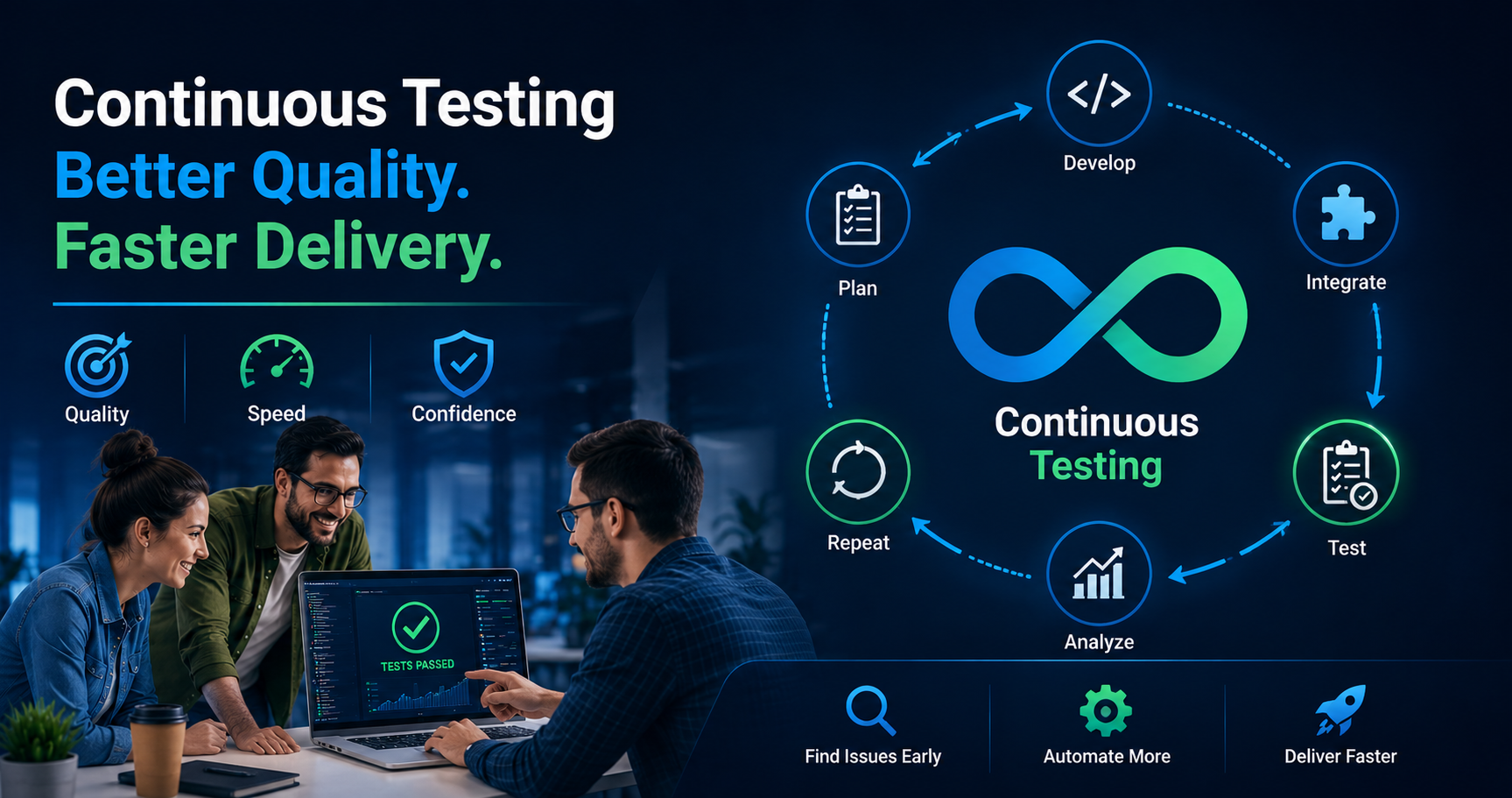
Continuous testing is an approach where software testing takes place continuously throughout the development process.
Instead of waiting until a feature or product is almost complete, teams perform testing at different stages of development. This allows potential issues to be identified earlier and gives developers faster feedback.
The approach fits naturally with Agile development because Agile teams work in short development cycles and continuously deliver changes.
A continuous testing process can include activities such as:
- Functional testing
- Automated testing
- Regression testing
- Performance testing
- Test data management
- Test result analysis
- Continuous validation of software changes
The goal is not simply to run more tests. The goal is to make testing an integrated part of software delivery.
Why Continuous Testing Matters for Agile Teams
Agile development focuses on delivering working software in short iterations.
This means development teams may introduce changes frequently. A feature can be developed, modified, tested, and released within a relatively short timeframe.
Traditional testing processes can create bottlenecks in this environment.
If testing starts only after development is completed, QA teams may have to evaluate a large number of changes at once. When defects are discovered late, developers may need to revisit code they completed days or weeks earlier.
Continuous testing changes this workflow.
Testing becomes part of the development cycle, allowing teams to receive feedback while changes are still fresh.
Faster Feedback for Developers
One of the most important benefits of continuous testing is faster feedback.
When a test identifies a problem soon after a code change, developers can investigate it immediately.
This reduces the risk of defects remaining hidden until the end of a sprint or release cycle.
Faster feedback can also improve collaboration between developers and QA professionals because both teams have a clearer understanding of the current software quality status.
Earlier Defect Detection
The earlier a defect is discovered, the easier it can generally be to understand and address the underlying problem.
Continuous testing helps teams identify issues throughout development instead of relying primarily on final-stage testing.
For Agile teams, this is particularly valuable because frequent changes can introduce regressions or unexpected behavior.
Regular testing provides an additional layer of protection as the application evolves.
How Continuous Testing Improves Software Quality
Continuous testing contributes to software quality in several ways.
1. It Detects Problems Earlier
Testing throughout the development process gives teams more opportunities to identify defects.
Instead of discovering a problem shortly before release, a team may detect it immediately after the related change is introduced.
This creates a shorter feedback loop between development and QA.
2. It Supports Consistent Testing
Automated tests can execute the same scenarios repeatedly.
This is particularly useful for regression testing, where teams need to verify that existing functionality continues to work after new changes are introduced.
Consistent test execution can help teams maintain quality as applications become larger and more complex.
3. It Reduces Regression Risks
Every software change can potentially affect existing functionality.
For example, a new feature may interact with an existing checkout process, authentication workflow, API, or user interface.
Continuous testing helps teams regularly validate existing functionality and identify regressions earlier.
4. It Improves Release Confidence
When testing takes place continuously, teams have more information about software quality throughout the development cycle.
This can help stakeholders make better release decisions.
Instead of asking, “Is the software ready?” immediately before release, teams can monitor quality throughout development.
The Role of Test Automation in Continuous Testing
Test automation is an important component of continuous testing.
Agile teams often need to run the same tests repeatedly as new code is introduced. Performing every repetitive test manually can consume significant time.
Automated tests can execute predefined scenarios repeatedly and provide faster feedback.
For example, an automated regression suite can be executed after significant code changes to check whether existing functionality still behaves as expected.
Automation Does Not Replace Testers
Continuous testing does not mean eliminating manual testing.
Human testers continue to play an important role in areas that require judgment, exploration, usability evaluation, and risk analysis.
Automation is most valuable when it reduces repetitive work and allows QA professionals to focus on activities that require human expertise.
A balanced testing strategy can combine:
- Automated regression testing
- Functional testing
- Exploratory testing
- Performance testing
- Test data management
- Manual validation where appropriate
This combination can help Agile teams achieve both efficiency and software quality.
Continuous Testing Across the Agile Workflow
Continuous testing works best when it is integrated into the broader Agile workflow.
A simplified process might look like this:
Plan → Develop → Test → Analyze → Fix → Retest → Release → Monitor
Testing is not a single step at the end of the process.
Instead, it interacts with development throughout the lifecycle.
During Development
Developers make changes and testing activities begin as early as practical.
Automated tests can validate repeatable scenarios, while QA professionals can focus on additional test coverage.
During Integration
As different components come together, testing can help identify integration problems.
This is particularly important for applications that depend on multiple services or components.
Before Release
Teams can execute regression, functional, and performance tests to evaluate the current state of the application.
The resulting information can support release decisions.
After Changes
Testing does not necessarily stop when a release is completed.
New changes can trigger additional testing cycles, creating a continuous feedback loop.
Continuous Testing and Software Quality Metrics
An effective continuous testing strategy should provide visibility into quality.
Simply running tests is not enough. Teams also need to understand what the results mean.
Useful information can include:
- Test execution status
- Failed and passed test cases
- Defect information
- Testing progress
- Testing effort
- Quality trends
- Release readiness
Clear reporting helps QA managers and development teams identify potential risks.
For management, dashboards and visual reports can make testing information easier to understand and support more informed decisions.
How Test as a Service Supports Continuous Testing
Building an effective continuous testing process requires more than automation tools.
Teams also need testing expertise, appropriate processes, test data, reporting, and enough capacity to support frequent development cycles.
This is where Test as a Service can provide additional support.
A tTaaS model allows organizations to access professional testing capabilities without requiring every testing function to be managed entirely within the internal team.
For Agile organizations, this can be useful when testing requirements grow faster than internal QA capacity.
How tTaaS Can Support Agile Continuous Testing
TDG’s tTaaS solution provides a comprehensive testing portfolio designed to help organizations improve software quality and accelerate delivery.
Its services include:
- Functional testing
- Test automation
- Test data management
- Performance testing
These capabilities can support different stages of an Agile testing process.
Functional Testing
Functional testing helps teams validate whether software features behave as expected.
Within an Agile workflow, functional testing can be incorporated into development and release cycles to provide feedback on new functionality.
Test Automation
Test automation can help Agile teams execute repeatable test scenarios more efficiently.
Automated testing can reduce repetitive manual effort and provide faster feedback when software changes are introduced.
This makes automation an important part of a continuous testing strategy.
Test Data Management
Testing requires appropriate data.
tTaaS provides test data management services designed to create, manage, and deliver test data to application teams in a structured and efficient way.
This can be especially relevant for organizations following Agile and DevOps methodologies.
Performance Testing
Software quality also depends on how an application performs under expected workloads.
Performance testing can help identify potential performance problems and provide additional insight into application behavior.
Including performance testing in a broader testing strategy helps teams evaluate more than functional correctness alone.
Real-Time Visibility for Agile Testing
Continuous testing works best when teams can see what is happening.
tTaaS supports real-time test case tracking through ClickUp, along with accurate time reporting.
Testing activities can be managed through a centralized professional platform, helping teams coordinate testing tasks and monitor progress.
This provides visibility into:
- Test case status
- Testing progress
- Team activities
- Resource allocation
- Testing effort
- Project timelines
For Agile teams, this visibility can make collaboration easier and help stakeholders understand the current state of testing.
Agile Workflow With Kanban and Gantt Planning
Agile teams often need flexible ways to organize work.
tTaaS supports Kanban and Gantt-based planning, providing visual ways to manage testing activities and project timelines.
Kanban-style workflows can help teams visualize ongoing tasks.
Gantt-based planning can provide a broader view of timelines and dependencies.
Together, these approaches can support better alignment between development, testing, and project management activities.
Transparent Test Hour Tracking
Resource visibility is another important aspect of managing continuous testing.
tTaaS uses real-time system logs to track test hours and automatically deduct them from the allocated service balance.
This creates a more transparent and auditable approach to testing resource consumption.
For QA managers and business stakeholders, transparent tracking can make it easier to understand how testing resources are being used.
Why Continuous Testing Is Valuable for Business Teams
Continuous testing is not only a technical practice.
It can also provide business benefits.
When teams identify problems earlier, they can reduce the risk of late-stage testing delays.
When automated testing reduces repetitive work, QA resources can focus on higher-value activities.
When testing progress and quality information are visible, managers can make decisions with greater confidence.
These factors can contribute to a more efficient software delivery process.
Faster Time-to-Market
Agile organizations often compete on their ability to deliver improvements quickly.
Continuous testing supports faster feedback, while automation can reduce repetitive testing effort.
Together, these practices can help teams maintain development speed without ignoring software quality.
Better Resource Efficiency
Teams can allocate manual testing resources to activities that require human judgment while automation handles suitable repetitive scenarios.
This can improve how QA resources are used.
More Reliable Releases
Continuous validation gives teams more opportunities to identify defects before release.
As a result, teams can build greater confidence in the software they are preparing to deliver.
Best Practices for Implementing Continuous Testing
Organizations adopting continuous testing should focus on building a sustainable process rather than simply adding more automated tests.
Start With High-Value Test Scenarios
Not every test needs to be automated immediately.
Start with important and frequently repeated scenarios. These usually provide the greatest value from automation.
Integrate Testing Early
Testing should begin as early as practical in the development lifecycle.
Early testing reduces the likelihood that teams discover large numbers of issues just before release.
Combine Automation and Manual Testing
Automation is powerful, but it should complement rather than replace professional QA expertise.
Use automation for repeatable scenarios and manual testing where exploration, usability, and judgment are important.
Monitor Test Results
Teams should regularly review test results rather than simply collecting them.
Failed tests, recurring defects, and quality trends can reveal areas that need attention.
Keep Test Data Organized
Poor test data can slow down testing and create unreliable results.
A structured test data management process can help teams maintain more consistent testing environments.
Make Results Visible
Testing information should be accessible to the people who need it.
Dashboards, real-time tracking, and clear reports can help development teams, QA managers, and business stakeholders understand progress.
Is Continuous Testing Right for Every Agile Team?
Continuous testing can be valuable for many Agile teams, but the implementation should match the organization’s needs.
A small team with a simple application may not need a highly complex testing infrastructure.
A large organization with frequent releases, multiple applications, and complex workflows may benefit from a more comprehensive continuous testing strategy.
The important point is to start with the organization’s actual risks and requirements.
Teams can gradually introduce automation, expand test coverage, improve test data management, and increase testing visibility as their needs evolve.
Conclusion
Continuous testing helps Agile teams integrate quality assurance into the software development process instead of treating testing as a final step.
By combining early testing, automation, functional validation, performance testing, organized test data, and continuous feedback, teams can identify problems earlier and make software quality a shared part of the development process.
For organizations that need additional testing expertise or capacity, Test as a Service can complement internal QA teams. TDG’s tTaaS provides functional testing, test automation, test data management, and performance testing, together with real-time test tracking, transparent resource monitoring, and Agile workflow management.
Ultimately, continuous testing is about creating a faster feedback loop between development and quality. When that loop works effectively, Agile teams can move quickly while maintaining greater confidence in the software they deliver.
Frequently Asked Questions
What is continuous testing in Agile?
Continuous testing is an approach where testing is integrated throughout the Agile development lifecycle. Instead of testing primarily at the end of a project, teams continuously validate software as changes are developed.
How does continuous testing improve software quality?
Continuous testing helps teams identify defects earlier, validate changes more frequently, reduce regression risks, and receive faster feedback during development.
Is test automation required for continuous testing?
Automation is not the only requirement, but it is an important component of an efficient continuous testing strategy. Automated tests can execute repetitive scenarios quickly and consistently, while manual testing remains valuable for exploratory and judgment-based activities.
How does continuous testing support faster software delivery?
By providing earlier feedback and reducing repetitive testing effort through automation, continuous testing can help Agile teams identify problems sooner and avoid large testing bottlenecks near release.
Can Test as a Service support continuous testing?
Yes. A Test as a Service model can provide additional testing expertise and capacity. tTaaS offers functional testing, test automation, test data management, and performance testing to support organizations’ software quality processes.
Yes. A Test as a Service model can provide additional testing expertise and capacity. tTaaS offers functional testing, test automation, test data management, and performance testing to support organizations’ software quality processes.